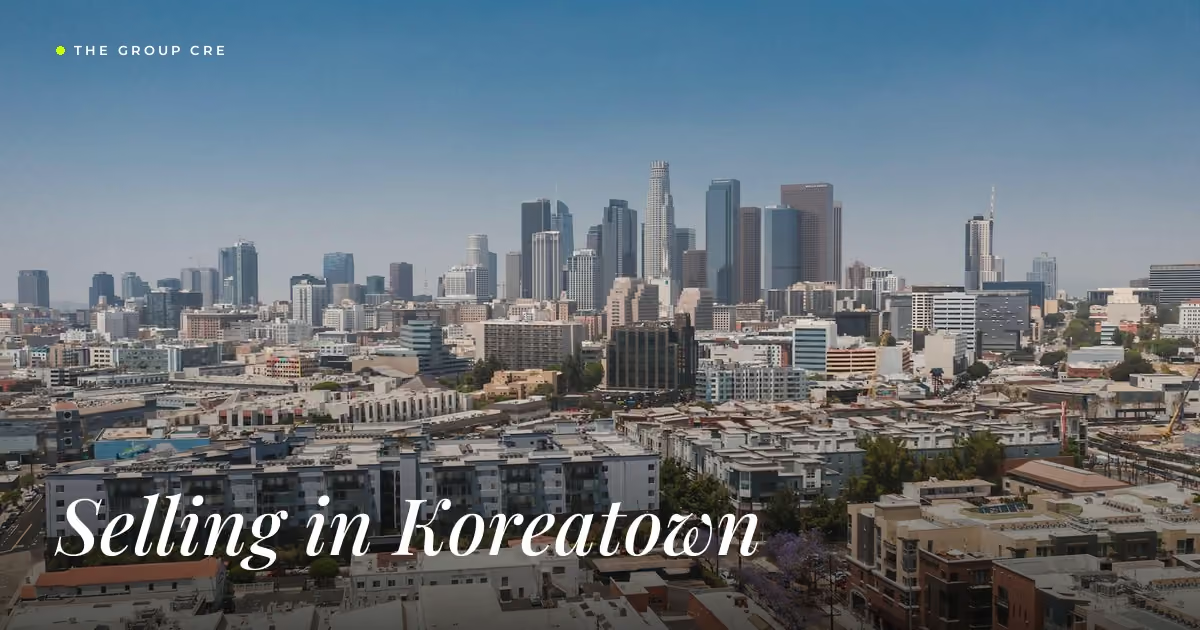
I've been selling apartment buildings in LA for years, and if I had to pick the one submarket that's gotten the most attention in the last three to four years, it's Koreatown. And honestly, it makes complete sense once you actually walk the neighborhood and understand what's driving demand.
Koreatown sits in this sweet spot geographically. You're talking about a neighborhood that's dense—thousands of units packed into a relatively small footprint between Wilshire and Romaine, roughly Vermont to La Brea. That density matters because it means operators can manage portfolios efficiently, maintenance costs stay reasonable, and there's built-in demand just from people who want to live there.
The transit situation is huge. The Red Line runs directly through Koreatown, which means people can actually live there without a car—a rarity in LA. We've got the Wilshire/Normandie station, Wilshire/Western, Vermont/Sunset—these are real access points. Young professionals, families, anyone thinking long-term about quality of life—transit accessibility moves the needle. And it moves the needle for investors too, because stable, walkable neighborhoods with good transit tend to appreciate steadily.
Then there's just raw demand. Koreatown has this cultural hub status that keeps it vibrant. Restaurants, nightlife, services—everything someone needs without leaving the neighborhood. That's not flashy, but it's incredibly durable. People choose to live in Koreatown because they actually want to, not just because it's affordable-adjacent to something else.
If you're thinking about selling right now, you need to understand where the market is pricing Koreatown. We're typically seeing cap rates in the 4.2 to 5.2 percent range, and that's a pretty wide band because it depends on what you're selling. A newer building with good tenancy and minimal deferred maintenance? You might see a 4.2, 4.4 percent cap. An older building with more upside potential but needing work? You could see 5.0 to 5.2 percent.
Price per unit is running between $250,000 and $400,000 plus. I've sold 20-unit buildings for around $5 million, and I've seen newer or better-positioned 25-unit buildings go for $10 million or more. The buildings on or near Wilshire, especially ones near the Red Line stations, command clear premiums—maybe an extra $15,000 to $25,000 per unit just for that location advantage.
Gross rent multiplier in Koreatown typically runs 12 to 15x. That means if your building is bringing in $300,000 a year in gross rent, you'd expect to sell it somewhere in the $3.6 to $4.5 million range. These are rough numbers because every deal is specific, but they give you a framework for what's realistic.
What I tell my clients is this: Koreatown is competitive. You'll get interest from institutional investors, smaller local buyers, and 1031 exchangers coming out of deals in Santa Monica or West LA. That's good for sellers because you've got multiple buyer types. But you need to price it right. Being overpriced doesn't work here—there's enough supply and buyers know exactly what things should be worth.
Here's where things get interesting and where a lot of sellers miss their real value. The vast majority of Koreatown's apartment inventory was built before 1978, which means it's subject to the Rent Stabilization Ordinance. That caps annual increases at somewhere between 3 and 8 percent depending on the year.
This creates what we call loss-to-lease. It happens when the regulated rent is significantly below what the market would support. I've seen buildings in Koreatown where existing tenants are paying $1,200 for a two-bedroom while comparable vacant units are renting for $1,600 or $1,700. That's a loss-to-lease situation, and it's actually a feature for institutional buyers and experienced operators.
Under Costa-Hawkins, when a tenant voluntarily vacates, you can reset that unit to market rent. So that $300 per unit gap times 20 units equals $72,000 a year in potential income recovery. A buyer should be willing to pay premium prices for that upside. You're essentially selling them the opportunity to go from managing a stabilized asset to operating it with rent growth embedded in the business plan.
For owners considering whether to sell, understanding the RSO situation is critical. If you're sitting on a building with heavy loss-to-lease and you're not going to actively manage the turnover and rent increases, you're leaving money on the table. But if you're tired of the management complexity, selling to a buyer who understands the RSO upside makes sense. They'll pay for that potential, and you get your capital out clean.
The physical stock in Koreatown is distinctive, and understanding which type you own is important for positioning it correctly.
The workhorse is the mid-rise from the 1960s through 1980s—typically 10 to 30 units, four to six stories, concrete construction. These buildings are solid. They've been through decades of use and they're still standing. Not fancy, but they hold value well and operate efficiently. These typically sell in the $4 to $8 million range depending on condition and location.
Then there are the dingbats—one or two-story walk-ups with four to eight units built in the 1950s through 1970s. Dingbats are challenging right now because of earthquake safety and seismic upgrade requirements. But they're also attractive to developers because the land value can be significant. If you're selling a dingbat, you might have development-angle buyers interested, which opens up your buyer pool.
The older courtyard buildings are beautiful—1930s through 1950s construction, 12 to 40 units arranged around a central courtyard, maybe a pool. These have character and tend to rent well because the space and light attract tenants who'll pay for them. They require more careful management because of their age, but they command psychological premiums because they feel like actual communities.
Understanding your likely buyers shapes how you position your asset for sale. Local and regional investors still dominate—people who know LA intimately, who maybe already have Koreatown buildings, and who see value in controlling multiple assets. These buyers are price-sensitive and move fast when they see something good.
Institutional capital has definitely increased. Acquisition groups from larger REITs, institutional investors managing portfolios, and groups with 1031 exchange money from other California markets. These buyers care about cap rates, tenant profile, building condition, and scalability.
1031 exchangers are a huge part of the market. These are people who've sold property elsewhere and have a tight timeline to reinvest. Koreatown appeals because it's close to other LA markets, not as expensive as trophy properties, and there's enough stock to give them options. If a 1031 buyer is at the table, the transaction usually gets easier.
One thing I discuss with sellers is development potential in Koreatown. ADUs are increasingly viable, and older buildings often sit on parcels with additional space. A dingbat with extra land could accommodate an ADU, turning a 20-unit operation into 21 or 22 units. That should factor into your pricing conversation.
Lot consolidation is also possible. Properties in Koreatown are smaller and closer together, making it feasible for a buyer to acquire adjacent lots and develop something bigger. If you know a buyer is trying to assemble land, you might have more leverage than you realize. These development angles don't apply to every building, but they're worth understanding before you list.
Location within Koreatown matters enormously. Wilshire corridor is the power location—properties on or adjacent to Wilshire command premiums of $20,000 to $40,000 more per unit. Wilshire has visibility, traffic, and the Red Line stations that anchor demand.
Near the metro stations more broadly matters. Wilshire/Normandie, Wilshire/Western, Vermont/Sunset—buildings within a few blocks of a station outperform buildings further away. It's worth a clear premium.
Residential blocks south of Wilshire toward Olympic or north toward Sunset can actually be attractive to certain buyers. These areas feel less commercial and appeal to people who want urban living without total density. Don't undersell that character.
If you've owned your building for 10 or 15 years and you're done managing, selling now makes sense. Cap rates are reasonable, buyer interest is strong, and you're capturing appreciation from your holding period. You're not leaving massive money on the table in today's market.
If you've got significant loss-to-lease and don't want to execute the rent-up yourself, selling is also the move. A buyer will pay for that upside, and you avoid years of managing turnover. Sometimes the best return is the one you don't have to work for.
If you're looking at a five to ten-year horizon and can handle active management, holding could be smarter. Koreatown's fundamentals—transit, density, demand—aren't going away. But be honest about the management piece. If you hate doing it, holding is just delaying inevitable pain.
Selling an apartment building is different from selling a house. You're selling a business—the residents are customers, the income is revenue, and the operation has complexity. In Koreatown especially, where RSO, building age, and tenant mix all play into value, you need someone who understands specifically multifamily operations and the Koreatown market.
If you want to talk through where your building stands and what realistic pricing might look like, I'm here for that conversation. No pressure, just expertise. That's what we do at The Group CRE.
Selling in Koreatown? Explore our Koreatown apartment building sales page for current cap rates, recent sold comps, and a free, no-obligation valuation of your building.
Koreatown typically trades in the 4.2-5.2% cap rate range, depending on building class and condition. Price per unit ranges from about $250K for older courtyard buildings up to $400K+ for newer or better-located properties. Buildings near Wilshire or metro stations command premiums.
Most Koreatown buildings were built pre-1978, so they're subject to RSO with annual rent increases capped by law. This creates significant loss-to-lease if units are well below market—sometimes $200-400/month per unit. For buyers, this is actually attractive because vacancy decontrol lets them reset rents at turnover. For sellers, highlighting the upside potential rather than current income is key.